Feb 22, 2012

Russia Makes War Films too...


August 2008 - in cinemas from 21st February 2012

What is true? Who can we trust? What is history? What is going on now? What is right? Who is good?  

Every day of our lives we are bombarded with answers to many of these questions. These answers may only be opinions, theories, ideas or constructs, but they are usually presented as hard facts. And we accept them. In Geopolitics these ‘answers’, which form the frameworks by which we live our lives, are called discourses. They are not intrinsically good or bad. They help create a stable society. They give people an identity and a history they can be proud of. They generate national unity. 
In Britain, we believe that we have not only a right, but a responsibility to be a world leader. We expect our politicians to maintain our global influence. We don’t often remember that we are a small island where less than 1% of the world’s population lives. We have this responsibility, or ‘duty’, because ‘our’ values - honour, dignity, democracy, freedom - are worth sharing. We dare to claim these as ‘our‘ values because of our history. We twice fought to ‘save‘ Europe in the World Wars and we ‘won’. In WWII, we like to think that we stood alone, conveniently forgetting the Soviet Union’s immense sacrifice (20 million citizens) on the Eastern Front. Every British child knows all about the Blitz, when the Nazis bombed London, but how many Brits know about how we firebombed Dresden, using incendiary bombs so destructive that even the ‘rocks burned’. Many of us take pride in our former empire - through which we tamed ‘barbarians‘ the world over to the extent that they even learned to play cricket! We forget the abhorrent racist views held by most imperialists, and some of the violent things we did to stop the locals doing anything ‘not cricket’. Going further back, we remember Francis Drake as a hero. The rest of the world remembers him as a Pirate, which is exactly what he was. 
Anyway, enough about history. The point I’m trying to make is that every nation has a selective memory on which it constructs it’s identity. It then uses this identity to interpret the present - Britain did a pretty good job of running half the world in the 19th century and has always stood up for respectable values. Therefore it ought to have a big say in how the world is run (UN Security council, G8 etc). Countries which agree with us on things like democracy and capitalism and want to join NATO are good. Countries which don’t (and especially their leaders) are bad.
And, at long last, that gets me on to Russia, which, like us, has a comprehensive set of "discourses" to explain its history and place in the world. The newly released August 2008, which I watched today, is an attempt to do that. It's a film about what Russia calls "Georgia’s 2008 invasion of South Ossetia". In the West, our predominant discourse leads us to call it something else: "Russia's 2008 invasion of Georgia". The rationale is simple. Russia, with its corrupt, authoritarian, openly-hostile-to-the-West regime must be the aggressor, the invader, the baddy. Georgia, whose people took to the streets in the Rose Revolution to kick out a Russian crony and install pro-Western, anti-Russian (and slightly insane) Mikhail Saakachvili as President is, naturally, cast as the goody. It helps that they were the underdog too (we Brits do love the underdog). 
Last year at university I wrote an essay about the conflict which I’m a bit ashamed of now. I remember that, as I wrote it, I dismissed everything from the Russian side as propaganda, while being prepared to accept almost everything the Georgians said at face value. And I ended up with a very unbalanced essay, albeit it one which BBC or Economist correspondents would have largely agreed with judging by their coverage of the conflict (and which an academic with a special interest in the region gave a good grade to).
Tonight’s film showed the other side of the conflict. The film tells the story of a mother trying to find her son who was visiting his father and grandparents in South Ossetia when war broke out. The most poignant moment of the film is probably when a Georgian tank (donated by the USA) arrives at the family home. The boy’s father goes out to meet it. He holds out his helmet. On it are the Russian letters МС - Миротворческий Сыль - Peacekeeper. He smiles. The Georgian tank blows him to pieces from close range. While this is happening, the boy’s mother is in the South Ossetian capital, Tskhinvali, which is being blown to pieces by Georgian artillery. Only after all this has happened does President Medvedev give the order to the Russian army to cross the border in order to protect the Peacekeepers and the peaceful population of South Ossetia. 
His own side warns him that the West will blame Russia and call it the aggressor. Of course, this is exactly what the West did - it chose to believe the Georgian account - that their troops only entered Ossetia from the South in response to a Russian ‘invasion’ from the North. 
The story of the conflict portrayed in the film is as one-sided (and probably as inaccurate) as the one portrayed in the Western media. It is as much an exercise in propaganda as Hollywood blockbusters about heroic American soldiers in the Middle East, and as the Hollywood pro-Georgian film 5 Days in August released last year. And, however historically accurate or inaccurate it might be, its portrayal of Georgian soldiers as killers of weaponless peacekeepers who are willing to sniper a defenseless mother certainly won’t improve Russo-Georgian relations. 
So I don’t agree with everything in the film. To use Geopolitics speak, it is a ‘tool’ in the hands of ‘intellectuals of statecraft’, used to construct a framework through which Russians are encouraged to view an important event in their recent history. To use more comprehensible speak, it is a biased, embellished and one-sided version of events designed to manipulate emotions, increase national pride and support for Russia’s leaders two weeks before presidential elections.  
But it is also a good film. The plot is gripping and moving. The setting is spectacular and their are numerous memorable moments. There is also one unexpected event which offers hope for a better future. The mother and son are found by a Georgian soldier who, seeing them driving a Georgian jeep (she has stolen it) points his gun at them. We fear the worst. But not only does he not shoot her - in thickly accented Russian he points out that if the Russians see her in a Georgian vehicle they will shoot at her. He takes the wheel and drives her safely to a place where Russian troops will soon pass. 
We have to view the world through frameworks or discourses. Without them we’d be lost, confused and directionless. I just wish that these frameworks rested on events like the one above - which show our human capacity for kindness, understanding and love, which disregard our differences, forget about friends and enemies and move us towards a world where there is no “us and them” or “friends and foes” - A world in which everyone works together so that people can enjoy a beautiful place like South Ossetia in peace. A world in which everyone can “live as one”. Maybe it’s naive to think like that. Maybe I’m just a dreamer… but I’m not the only one ;)

Feb 17, 2012

Putin, Russia and the West. BBC at it's best


The media loves to take sides, to create heroes and villains, to embellish, exaggerate, oversimplify and generally distort the truth. Of course, we all know that the press in nasty, autocratic places like Syria, China, Iran and Russia do this… but our press (or at least our broadsheets) are largely unbiased and objective aren’t they? And if the newspapers aren’t, then at least we can always rely on that bastion of truth, sitting serenely in an oasis of objectivity - our very own BBC. Can’t we? 
Even since the protest movement started I’ve been disappointed by the BBC’s coverage of Russia. Whether Daniel Sandford and Steve Rosenberg, their Russia correspondents don’t speak Russian and reality has been lost in translation, whether they’re stuck in a Moscow bubble or whether they are just seeing the world through West-tinted spectacles I don’t know, but the Russia they’ve portrayed is a far cry from the one I live in. From the outset they have not only seemed determined to portray the fair-election protesters as representative of the whole Russian people, they have also misrepresented the protesters themselves. I remember being shocked to read the headline on the BBC website “Russia protesters call on Putin to go” (December 24th). I’ve not heard anyone make that demand - the protesters have consistently stated their wish for a re-run of December’s parliamentary elections and the resignation of the election commissioner. No-one’s asking Putin to resign. They have chanted “Russia without Putin” and pledged not to give him “a single vote”.  But they’re also united in their desire to bring about change through fair elections, not a revolution led by the street, as in Egypt, Tunisia and Libya. That’s why use of phrases like “Moscow Spring” (favoured by the Economist magazine) is also unhelpful. This is a very, very different situation. 
Having said all that, the documentary “Putin, Russia and the West”, recently screened on the BBC goes a long way towards making up for the failings of its correspondents. In four hour-long episodes it tells the story of Putin’s 12 years as Russia’s ‘natural leader’. Apart from some rare, unhelpful comments by the narrator, the documentary seems very objective as it searches for the truth behind some of the most important events of the last decade, including September 11th, American plans to increase nuclear defence in Eastern Europe, the Orange Revolution in Ukraine, the 2008 war in Georgia, the ‘reset’ in Russo-US relations when Obama became President and the Putin-Medvedev “tandem” government. Whenever possible, influential people on both ‘sides’ of events are interviewed, and the makers assembled an impressive cast list, including Condoleeza Rice (George and Colin Powell (US secretaries of State under Bush), Gerhard Schroder (former German chancellor), David Miliband (former UK foreign minister), Mikhail Saakachvili (President of Georgia), Leonid Kuchma and Victor Yushenko (former Presidents of Ukraine), Igor Ivanov and Sergei Lavrov (Russian foreign ministers) and a whole host of advisors, ambassadors and negotiators who were there when big decisions were made.
An indication of the documentaries’ overall objectivity is the way that non-objective people have responded online. The first episode, which concludes with the arrest and sentencing of Mikhail Khodorkovsky is attacked by Putin supporters, who deride it as typical Western propaganda because of the way Khodorkovsky is treated like a martyr. Many Russians think he got what he deserved. The third episode deals at length with the war in Georgia. Conventional wisdom in the West says that poor, innocent little Georgia was invaded and crushed by mighty, evil Russia. I even wrote an essay at university last year propagating that view. In reality, it was much more complicated and both sides were guilty of provoking the other. The documentary makes this very clear, which is why anti-Putin people accused the film-makers of pro-Putin bias. 
In a subsequent blog I’ll outline what I learned from the documentaries. But before you read that I’d go and watch them for yourselves (especially the fourth one, which brilliantly captures the complex Putin-Medvedev relationship). They’ll be on iplayer for another week or so. Otherwise, you can find them on youtube at …

Feb 14, 2012

Why Putin will be the next President, and why the Economist is wrong.


In an article this week titled “A Moscow Spring?”, the correspondent for the Economist claims that Vladimir Putin “seems determined to win the presidential election on the first round, even though this will require overt rigging”. The correspondent is right about Putin’s determination to secure a resounding victory which confirms his self-proclaimed status as Russia “natural leader”. He’s wrong that overt rigging will be required to do so. Without any rigging at all I’m quite confident that Putin would win 60% of the vote, well over the 50% he requires to avoid a second round. Here's why... 
In December’s parliamentary elections Putin’s party, United Russia officially gained 49.5% of the vote. Although it is hard to say how much this total was inflated by various illegitimate tactics, I think the ruling party probably gained closer to 40% of the vote. Considering their monopoly on free to air TV, their vastly greater financial resources and and their ability to control entry to the political system (it’s almost impossible for groups which genuinely threaten the ruling party to register), this is not a very impressive result, and reflects general discontent with the direction the country is going. Since then, some Russians, most notably middle class Facebook-users (the vast majority of Russians use vKontakte instead of Facebook) in Moscow, have expressed further discontent through the ‘fair elections’ meetings which have gained so much publicity in the West. 
The discontent is real. And it does extend beyond the Moscow middle class. United Russia’s unimpressive performance in December proved that, and I’m yet to meet someone who is really excited about the prospect of a third Putin presidency. However, this discontent will not lead a majority of Russians to reject Putin at the ballot box on 4th March. 
In part, this is thanks to Putin’s enduring popularity among a large part of Russia’s population, who appreciate his achievements in the early 2000s when his strong leadership got the nation back on its feet. However, it is the haplessness of the opposition candidates which really guarantees a comfortable, possibly even resounding victory for Putin. 
Vladimir Zhirinovsky is widely derided as a clown. Mikhail Prokhorov, however hard he tries to appear down to earth (I saw him this week rapping in broken English on Russia’s equivalent of Friday Night with Jonathan Ross), comes from the most disliked group in Russian society - the oligarchs. Gennady Zyuganov is a Communist, and nobody seriously wants to go there again. And most people don’t know who Sergei Moronov is. Over the next few days I’ll put together a profile of each one of them and explain why, if I was voting in Russia, I’d probably do what my host, 75-year old Tamara wants to do, and vote “Protiv vsex” (Against everyone). 

Why Putin will win - many of the thousands of people in this anti-protest march really support him.
Why the Economist is wrong - they photographed the wrong demonstration. This photograph accompanies an article supporting the fair elections protests in this week's print edition. But it is a photo of Putin's supporters. Oops. A poignant example of how Western media remains out of touch with the Russian reality. 


Feb 13, 2012

Real Russian Winter at last!


In the Bleak midwinter, frosty wind made moan
Earth stood hard as iron
Water like a stone
Snow had fallen, snow on snow, sno-ow on snow.
In the bleak midwinter
Lo-o-ong ago…
This is one of my favourite carols - the last verse expresses pretty what Christmas is all about. However, I’ve always had to suspend disbelief when singing the first verse, because I’m pretty sure that nobody’s ever skated on Lake Galilee, and I don’t think many drivers in Jerusalem bother to carry de-icers. I also find it pretty hard to imagine that the shepherds were digging their sheep out of a few feet of snow when the angels appeared. I’ve also had to use my imagination, because I’ve never really known a winter when snow fell on snow. My childhood winters were happily punctuated with occasional snowfalls, but it never stayed longer than a week or two. 
Maybe British winters were different in the pre-global warming world the composer was writing in. Or maybe she had visited Russia - where the earth has been hard as iron since new year, and the brave ducks of Petrozavodsk are surviving on an ever-shrinking opening at the fastest flowing part of the river, the only bit yet to turn to stone. Here, snow has fallen on snow, on snow, on snow… it’s everywhere - the whole region is covered in perfect powder. Shame there aren’t any mountains. 
However, the Russian midwinter is far from bleak. It’s brilliant. Every day the snow glistens in the sun, which slides through a crisp blue sky not far above the horizon. The feeling when -20 degrees air grips your face in the morning is exhilarating, even if I can’t breathe it in without coughing! The city has come to life - it was such a dreary place in December, when everything seemed grey and dilapidated. Now there are people everywhere enjoying all that winter has to offer. Couples walk together “touching gloves” - you can’t really hold hands in winter mittens. Determined fisherman drill holes in the metre-thick ice. Babushkas and Dyedushkas (Grandmas and Grandpas) totter about in fantastic fur hats. Children pour water down hills, creating ice-slides which they descend on their bums, backs, fronts and, if they are really daring, feet. Students go cross-country skiing in their PE lessons, and skating rinks are packed. Long suffering cars (and their drivers) are given some respite from their never-ending battle with potholes - snow and ice has filled all but the deepest gashes. And, after an hour or so out in the cold, it’s impossible not to love the feeling of coming in to a warm flat, taking off your outer layers and sitting down to a cup of steaming tea. 
Beauty is everywhere - enormous icicles can make even the grimmest Soviet architecture aesthetically pleasing. Ice makes intriguing patterns on windows. Frost twinkles on the branches of leafless trees, while the boughs of evergreens sag under a foot of snow. Steam billows into the brilliant blue sky from chimneys at water-heating plants in every part of the city. At dawn and dusk the sky glows orange or red for an hour. And at night the stars are magnificent - I’ve never seen Orion looking so imposing, and the Milky Way is clearly visible if you get out of the city. Even people are more beautiful - in fur hats, coats, colourful scarves and winter boots, with cheeks turned rosy-pink by the cold. 

Quite a few Russians told me last term that winter was their favourite season - I couldn’t understand why. For me, winter has always been dark, windy, wet, cold - a season for staying indoors. But real winter - Russian winter - is something else altogether. I love it. 


 This Lada's not going anywhere

 Hardcore ducks in Petrozavodsk
 Where I might learn to skate... 

Standing on the lake

Feb 8, 2012

Sorry I'm late...


Today I was 10 minutes late to my only two commitments. Those who know me will be unsurprised. For years the only quote on my facebook page was “Punctuality is the virtue of the bored”. I know it is a bad habit, but that doesn’t seem to solve the problem. It seems I am genetically programmed (and it runs in the family…) to leave at the last possible moment which still makes an on time arrival feasible (albeit unlikely). So I know that if I don’t have wait to cross the road, the bus arrives the moment I reach the bus stop and then all the traffic lights are green I can get to university in 20 minutes. So I allow 20 minutes. And, invariably, I arrive 5 minutes late, which my flawed consience considers permissible. But today 5 minutes slipped up to 10 minutes. Impolite slipped towards plain rude. And I didn’t get away with it. I’m writing this now because I was supposed to meet someone at 5:30 and I was 10 minutes late. I’d missed them, and to compound my crime, I left my phone at home. I couldn’t even call to apologise/check they weren’t even later than me (which, of course, I longed to be the case). As I stood in the cold waiting for someone who had already left I had the chance to ponder my crime, and my mind did what it has been trained to do from a very young age – found an excuse. And here it is.

It is cold here. It’s not very cold (that description’s reserved for when it goes below -25). But it’s cold enough (-13) to demand that as much skin as possible remains covered by wool, down or fur clothing. However, inside temperatures are verging on tropical. Once the general heating system (which pumps scalding hot water around a whole region of the city) is turned on in September residents can do nothing but strip down to their underwear and enjoy the heat or open the windows and let the freezing air flow in. Thermostats are nowhere to be seen. In my flat we go for the windows open option, which is easier on the eyes. But you still have to take a lot of clothes off to be comfortable. And that, in a very long winded sort of way, gets me on to my excuse!

Before leaving your tropical flat during the Russian winter it is necessary to put on a second pair of socks, which you tuck your long johns into, so that when you put your trousers on the long johns don’t ride up. Not forgetting to tuck your shirt into your underwear, you add as many jumpers as you see fit. My record so far is 4, which made me look like a veritable teddy bear. Next up, presuming you are still mobile enough in your many jumpers, are the boots. I’m reliably informed that trousers go in, not over winter boots, and that there is a special technique to tuck them in neatly which Russian men learn during military service. Not having had that 'privilege' I’m yet to master the technique, so I hurriedly stuff them in, tighten the boots so that no precious warm air can slip out and move on to the scarf. It also comes with a special technique I have not yet mastered. Once it is (un-)satisfactorily tied, the coat (fur or down) goes on and is zipped up to the top. Coats are serious business here. A good fur one costs well over a thousand pounds. But they are incredibly effective and beautiful attire, especially when topped and tailed with matching fur hat and fur lined boots. A well dressed Russian in winter is a sight to behold. I’m sad to say it isn’t such a privilege to see me in winter, with my sky blue puffer jacket, Quicksilver hat (made in China) and Quechua boots from Decathlon. But they keep me warm enough, and that’s the most important thing.

Anyway, as I ruminated on my repeated unpunctuality I realised that this dressing up palaver was making me miss my 5-minutes-late deadline. And so of course, from now on I will remember this and start getting ready to leave 5 minutes earlier… or maybe I can do it in 3…

Dec 13, 2011

It's hard to be lucky in Russia!


If all Russia’s superstitions were true I think someone you knew would die almost every day, you would be constantly arguing and almost constantly afflicted by bad luck! We discussed some today and I decided to share some. It makes a change from the political musings which have come to dominate my blog.

I came across one yesterday evening. I left my mobile phone at my friend’s house and, having gone down five flights of stairs (the lift, which stops at the fourth and sixth floors conveniently skips the fifth) I remembered and faced the stairs again. When I got back to the flat, I wasn’t allowed to just take the phone and disappear into the night. If I did so, something terrible would surely happen. It was absolutely essential that I smiled in the mirror before leaving. I objected – I didn’t want to take my boots off (and going into a Russian home with shoes on is NELZYA – forbidden), and anyway, I’ve had to come back for forgotten things hundreds of times without smiling in a mirror, and disaster hasn’t struck yet. However, I wasn’t allowed to ‘risk it’ – a pocket mirror was found, I put on my broadest smile and headed out the door, ready for anything!

Another superstition related to coming and going is that you mustn’t greet or say goodbye to someone across the threshold of their home. That means you’re sure to argue. Spilling salt also guarantees an argument. There are plenty of money related beliefs. Whistling indoors is a no-no. It will lead to poverty. Leaving empty bottles on the table is also asking for trouble – you’ll be out of money. And after dark take care not to put money in someone’s hand. If an exchange is necessary, put the money down and let them pick it up. Something positive which may come from this is the little money tray in every shop. This means that when you receive coins and notes as change you can pick them up separately out of the tray, instead of struggling to put the coins into the coin section of your wallet while holding onto your notes and receipt, a challenge I’ve still not worked out how to deal with in England!

If you’re hoping to get married any time soon, you’d better not sit at the corner of a table. For 7 years you won’t find some to tie the knot with. If you are in a relationship, make sure you don’t give your other half an even number of flowers. Someone will surely die!

It’s a good idea for students to put their textbook under their pillow the night before an exam. Apparently information will just stream in to your brain. But be careful not to wash your hair in the morning – because you’ll wash it all out again!

On top of these, Russians also worry about lots of the things we worry about. If a black cat runs across the road in front of you, you’d better pull over and let someone else be the next person to drive past. The 13th is an unlucky day, especially in May. In fact, May is a generally unlucky month (even though that’s when they won the Great Patriotic War (WWII)), because it is part of the word mayatsya, to suffer. It’s not only bad luck to walk under a ladder – anything which leans against something else is better avoided.

And there are plenty more – enough to justify a whole website (in Russian). You might have noticed that there isn’t much good luck going round, but fear not! It can be found! Trolleybus tickets all have a chain of 6 numbers of them. If the first 3 numbers add up to the same amount as the second 3 then you have to eat your ticket and you’re sure to be lucky! It’s probably easier to find than a four leafed clover, but I’m yet to find my lucky ticket…

Dec 10, 2011

Revolution in Russia?


Ben Hopkins, BBC news, Petrozavodsk... take a look!

A Russian Spring? Don’t count on it. And indeed, even comparing what happened in Russia today with what has happened and is happening in Tunisia, Libya, Egypt, Syria, Bahrain and Yemen is unhelpful. Almost nobody here is calling for a revolution. Very few want Putin to step down. He would almost certainly win next year’s elections even if state control of the media was ended, all parties were allowed to participate and votes were not falsified, which is exactly what protesters today were asking for. Chestnie vibori, narodnie prava  they cried in Petrozavodsk today. “Honest elections. Rights for the people!” And that is all they want.


Russians have had enough of revolutions. It is a dirty word here - ‘revolutionaries’ are about as popular here as anarchists are in the UK. Many believe that honest elections are the best medicine to fix society without another damaging revolution. I think they are right.


There were maybe 300 people at the protest in Petrozavodsk today (when I left after an hour or so). Significantly fewer than the 1000 who pledged to attend on vKontakte, Russia’s very own Facebook (which, incidentally, grants users free access to pretty much any film or song you can name… legal? This is Russia…), but still more than have taken to the streets here in recent memory. The group congregated on “Lenin Prospect”, outside the government building. Communists waved red flags, Anarchists waved black flags, and supporters of Fair Russia, a social democratic party wore yellow coats. Despite the crowd being made up of such a diverse range of people, it was very calm and all seemed united in their goal - fair elections. It was also interesting to see people of all ages there, not least my 75 year old host Tamara who, when I told her about the protest said - “Well, let’s go”, holding a clenched fist in the air! She even joined in briefly with one of the chants!


Tamara, my host, with the anarchists.


The police were almost redundant - protesters themselves made sure that a path was kept clear through the protests for pedestrians, and there wasn’t a hint of violence. In fact, most people didn’t even want to shout, and the chanting was largely left to the hard core Communists and Anarchists who are presumably more used to protesting. The rest seemed unsure what to do - it’s such a new thing for them - but they were determined to be there and make their presence felt. If protests continue (and there are plans for another next Sunday), no doubt people will work out what to do! 


This scene, of peaceful protesters, monitored by a heavy police presence, demanding free, fair elections, was repeated across Russia today, from Vladivostok to Kaliningrad. In Moscow over 30 000 took part in the biggest rally since 1991. Encouragingly, apart from a few scuffles in St Petersburg, all the protests passed without incident. The protesters are well aware that Putin’s party machine are ready to jump at any opportunity to portray the protesters as violent ‘revolutionaries‘ determined to de-stabilise Russia, which would make most Russians turn against them. And so they behaved impeccably, even the anarchists!

But will it make any difference? Most Russians are skeptical. When a country has been plagued by corruption for hundreds of years it’s hard for anyone to believe things will change just because a few thousand people take to the streets. Indeed, I don’t expect this movement to force United Russia from power any time soon. I certainly don’t think there will be a ‘revolution’, and I remain 99% sure that Putin will still win presidential elections in March. However, this is something new and I believe that it will make an impact. It was interesting that all the protest meetings today were permitted to take place - and if such meetings continue and grow larger, then pressure will inevitably build on the ruling party to make next year’s Presidential elections fairer and more open than the Parliamentary ones which took place last week. It won’t be enough to force Putin from power - most Russians still can’t imagine another leader, but in 2018, in largely free and fair elections, maybe Russia, for the first time ever, will see power transferred without a revolution. That is a dream worth taking to the streets for. 


Some video of the protests. They are demanding honest elections.

One of the police's few actions was to insist on a change to this sign... 
"A Recount won't make the elections fairer" 


Honest choice!
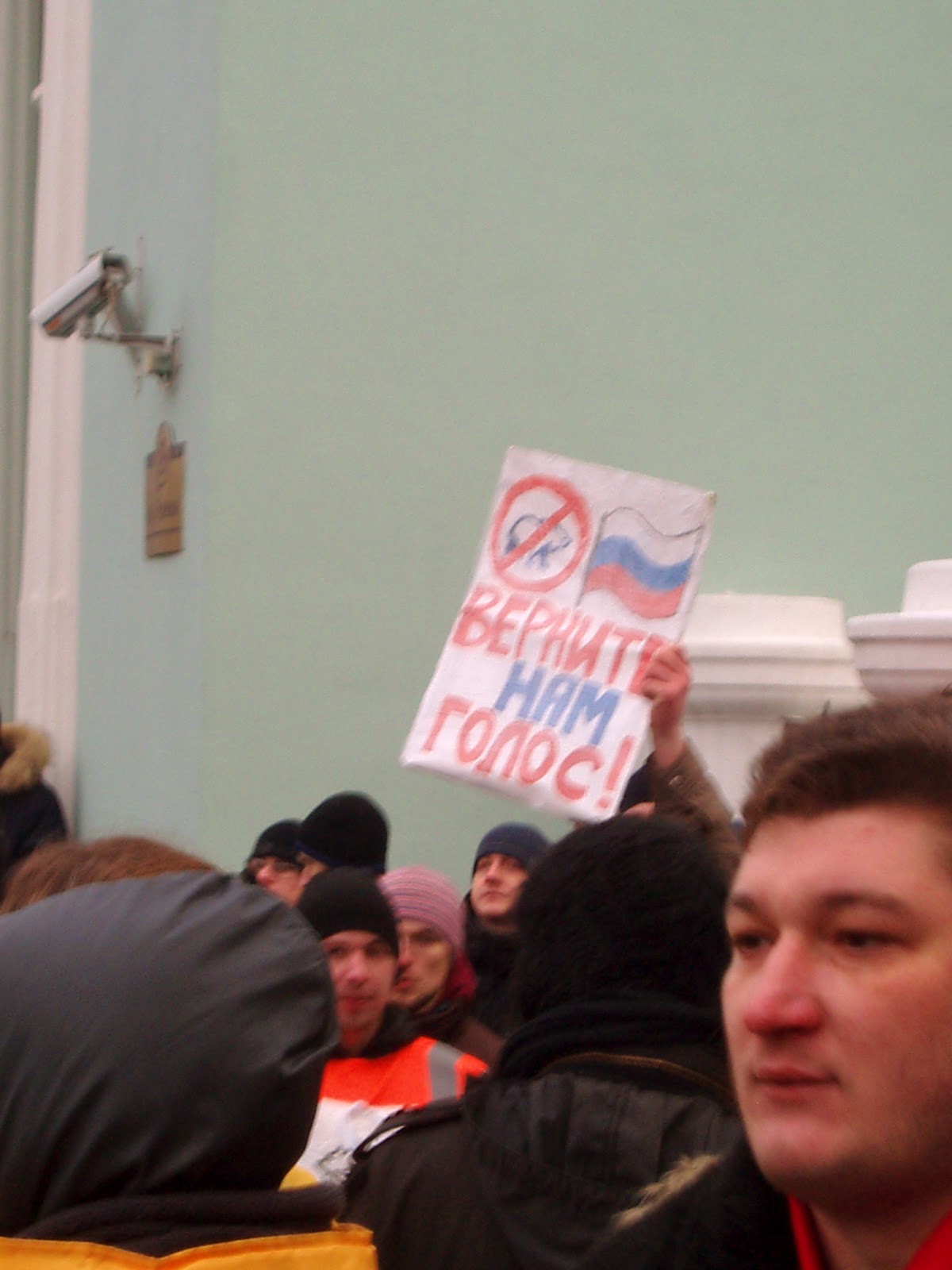
Give us our votes back!

Nov 29, 2011

Russian “Democracy”


On Sunday, Russians will go to the polls for Parliamentary elections. The result is not in doubt - one Russian not only told me today who would win the election, he also confidently foretold the result. United Russia, the party of Vladimir Putin and Dmitry Medvedev will win 54% of the vote. I replied “why not 70%?” With a look of pity at my naiveté, he told me “70% is not in fashion any more. 50 or 60% - this is democracy.

Though he was being sarcastic, he captured what seems to be the essence of the upcoming elections - to give the Russian people and the world the impression that Russia is a proper democracy. And if you don’t keep your wits about you, the very clever manipulation of media coverage and, to an extent, opposition parties might just make you believe it.

First - opposition parties. According to an opinion poll I saw today, the Communists are likely to come in second place in the election, with up to 20% of the vote. This however doesn’t worry the government too much. Most Communist voters are pensioners nostalgic for the good old days of the Soviet Union (presumably they have a selective memory…). And though Russian grandmothers are certainly a force to be reckoned with, they aren’t going to March on Red Square to try and bring down the Government (though I’d love to see them try!). And the young are never going to vote for the Communists, so, understandably, the ruling party doesn’t worry too much about them.

In third place in the opinion poll is LDPR (Liberal Democratic Party of Russia). Incidentally, their leader, Zhirinovsky is as much a figure of fun as our own Lib Dem leader Nick Clegg. And, also like Nick Clegg, he likes to make lots of noise against the government and then, when it really matters, vote with them. Zhirinovsky’s party is considered by some as a ‘clone’ party, controlled by United Russia but promoted as an opposition party in order to split the opposition vote. Whatever they are, they are no threat to Putin.

In fourth is “Fair Russia”. They seem to be genuinely opposed to the government, and they are at least making an effort. I’ve seen their people giving out newspapers in St Petersburg and Petrozavodsk, and some bus drivers have had their distinctive rising sun symbol blazoned across their bonnets. Despite this, or possibly because of it, they won’t get more than 10% when the official results are announced.

There seems to be a clear correlation between a party’s democratic credentials and its share of the vote, because in fifth, struggling to get the 5% of the vote required to enter the Parliament (Duma) is likely to be Yabloko (Apple in Russian, but Steve Jobs had nothing to do with it). This is my babushka’s favourite party, and from what I’ve managed to find out, they are mine too. Many Russians agree that they are “honest”, but they complain that they “don’t do anything”, which might be true, but when you aren’t in parliament (they didn’t get 5% last time) it is difficult.

Below them are the “Russian patriots”, whose party political broadcast looks like a 1970s Soviet propaganda movie (Rousing orchestral music, grainy images of the Russian countryside, slogans like “work in you country, take pride in your country, love your country), and who won’t be getting many votes on Sunday.

Such a fragmented opposition plays right into the hands of United Russia, who have also refrained from entering into the TV debates which representatives of other parties have been having every night on television. Maybe they think themselves above such things, or maybe they are afraid of being shown up. It’s a risk neither Putin or Medvedev, whose public appearances are all strictly stage managed, is willing to take. The debates themselves serve to highlight differences between opposition parties, which works for United Russia, which could only be seriously threatened by a united opposition movement.

Aside from debates, election coverage on mainstream channels is also strongly skewed in favour of the ruling party. Reports from small scale opposition gatherings are followed by clips of Putin addressing addressing a crowd of flag-waving thousands. Opposition adverts are outnumbered by those of United Russia’s, whose slogan “victory for Russia, victory for every one of us” is imprinted on my brain and probably the brains of millions of pensioners who never turn their radios off. And of course, wherever you go, Putin’s face is never far away, glaring down from a huge billboard and proclaiming that “Russia needs you”.

Having said all that, I’ve actually been surprised at how much coverage opposition parties have had, and at how freely they have been allowed to criticize the government, even on state television. It looks pretty democratic. And then I remember that I am yet to meet someone who says they will vote for United Russia. And I remember that despite this, according to official results, United Russia will win at least 50% of the vote on Sunday, because that how Russian Democracy works.

Nov 23, 2011

Volleyball is a real sport!


Yesterday I discovered a new sport - Volleyball. Of course, I’ve knocked a ball around on the beach and even played Birkdale School House Mixed Volleyball, but that game was about as similar to the one I played yesterday as primary school touch rugby is to the real thing.

At a time when I was blissfully unaware of this, and when my forearms weren’t bruised and my right thumb wasn't swollen like a chicken leg, I dared to suggest that a game of volleyball doesn’t constitute exercise. How wrong I was!

Even if I had arrived in sparkling volleyball kit, there was little chance of me looking like anything but a lost, clueless foreigner once I took to the court. As it was, I’d made a fool of myself before the game even began. I suppose I’m used to going to sports training wearing my trainers - however, when it’s -5 and there’s snow on the ground, winter boots are a better option - so I put on the boots, and left the trainers at home. Oops.

Naturally, I felt fairly stupid when I realised my mistake, but I thought nichevo strashnovo - no worries - I’ll play barefoot. After all - I was only going to play volleyball! How hard can it be?

The Russians wouldn’t let me play barefoot. Apparently it’s “too cold” and I’ll “get ill”. Not to be deterred I began to rummage through the lost property conveniently piled up in the corridor. Despite repeated assertions from the Russians that this was a school, that there were only children’s clothes, and the disappointment of finding shoes only to discover that they had 3 inch heels, I persisted and, to my delight, I found a pair which I could squeeze my size 6 ½ feet into.

After a quick lesson - hit the ball as high as you can, use your arms, don’t sleep - the game began. I must confess that I always associate volleyball in the UK with feelings of frustration at people who are determined to play, but don’t know what they are doing and therefore do more harm than good. Well, in Russia I am that person. Immediately identified as the weak link by the other team, the serves started flying at me. I never imagined that you could spin a volleyball, but as the ball swerved as it flew towards my stinging, pink forearms I realised that it must be possible. Unfortunately, knowing that the ball spins didn’t make it any easier to return it, and before long I had to endure the humiliating experience I’ve inflicted on plenty of others - my team mate came and stood right in front of me to ‘protect me’. I didn’t complain!

Once the rallies got going though I settled and started to get more confidence. In the UK a real 'spike' (smash) draws gasps of admiration from the other players. A block (when the defender jumps and blocks a spike back) happens once in a blue moon. Yesterday they happened every other point. It was the volleyball I'd always dreamed of (only in my dreams it didn't hurt so much). Even I managed a spike!

Unfortunately, my team didn’t do very well. Our numerical advantage was outweighed by the disadvantage of having a clueless foreigner on the team. We lost 3 sets  in quick succession before we got a foothold, taking a 20-19 lead in set 4 (first to 25, 2 clear). Both teams realised we had a game on our hands, and the score progressed to 26-25, our set point. It was my moment. The ball dropped down from high above the net…

I jumped…

For a magic moment I hung in the air and dreamed of glory…

 I struck the ball hard…

… And it hit the net. Gutted.

On the bright side, we won the set 30-28, and so avoided a whitewash. In the final set, normal service was resumed and we lost it 25 to not very many, but never mind. Afterwards, maybe hoping for some sympathy, I mentioned to one guy that I’d bent my thumb back and it was really painful. He cheerfully said - “ah, classic mistake. It’ll be fine in a week.” Which is just in time for the next game! Bring it on...